In this day and age, where globalization has intertwined the many cultures of the world, it's commonplace to discuss the values and practices of other cultures. What I've been hearing lately has been a lot of discussion revolving around the question "Is the veiling of Muslim women a sign of oppression or liberation?".
In Western society, I don't think it's much of a shock to assert that Western media shines a negative light on veiling. Seeing a woman walking down the streets of Chicago in a hijab, especially a burqa, stirs up controversy. The usual questions arise: "Who would make her wear that thing?", "Why would anyone wear that thing in the United States"?, and even "Is she a threat?". Anger, frustration, confusion. Americans are so used to the status-quo that anything different is considered bad. Typical American dress varies, but in general, we're used to showing a lot of skin. Bikinis, short shorts, and miniskirts are typically acceptable for women, and being topless in public is totally acceptable for men.
Appearance is so important to us, rightfully so, as it is the first thing we see when we look at people. However, it's truly difficult to justifiably say "This is the right way to look" or "This is the wrong way to look". We think burqas are oppressive? Take a look at this:
I love this photo because it really shows two opposite perspectives on one significant idea. Honestly, for those of you who are Americans or Westerners, have you ever thought of this perspective? That the way women dress in Western culture exemplifies a male-dominated culture?
Appearance has a lot to do with perspective. What I take away from this is that an individual must understand the reason why someone else dresses or appears the way they do. Preconceptions and rumors go a long way, but they are rarely true. Going back to veiling in Muslim societies, sure, some women may feel oppressed and forced when wearing a burqa. That's a possibility. However, there are undoubtedly veiled women who feel like the woman wearing the burqa in the comic. Women who cover themselves to feel modest and gain self-respect.
This article gives a pleasant, positive perspective on veiling. Take Dawud, the Muslim Student Association board member, as an example. Dawud said that "[the hijab] defines who I am as a Muslim woman. It is a constant reminder of my faith....As women, we tend to be constantly objectified and expected to play out certain roles. I feel like the hijab breaks that barrier down". See that? Here's a woman who not only feels proud that she wears a hijab, but also a woman who chose to wear it out of her own free-will. Not the sort of story you would expect to hear on typical American television, right?
So are veils always a positive sign? No, but I like to think that they aren't as negative as the Western media portrays them to be. Appearance is powerful and indicates plenty, however each individual's appearance has a complex back story. That being said, before we judge a tradition, let's do some proper research before coming to any major conclusions.
Sunday, December 16, 2012
Tuesday, December 4, 2012
Egypt- The Traps
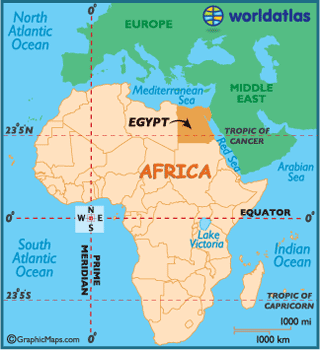
Every country has an image. This image is made up of its strengths, weaknesses, the way the country interacts, reacts, governs, etc. This image in turn affects a country's classification: how it would be ranked compared to other countries. The decisions a country makes and the circumstances a country is under can greatly affect its standing in the world. In The Bottom Billion by Paul Collier, Collier discusses some of the critical factors that affect a country's image. Specifically, the book focuses on the various "traps" that bring a country to be considered in the bottom billion. These four traps include: conflict, natural resources, bad governance, and being landlocked. To explore Collier's argument, I decided to focus in on Egypt, a country that has gone through a considerable amount of change in the past year, and see how its image correlates to these traps.

Firstly, Egypt is not considered to be in the bottom billion. However, that doesn't mean Egypt hasn't or doesn't deal with any of the traps Collier mentions. Let's start, though, with the traps Egypt does not deal with and how that affects Egypt's well-being.
Egypt is not landlocked. Though most countries that suffer from the landlocked trap are in Africa, Egypt happens to be located on the coast, making it able to take advantage of the Mediterranean Sea and Red Sea. Coastal access is vital for a country, as it links the country to strong trade routes. This allows Egypt to trade more easily with other countries and maintain a steady flow of imports and exports. For this reason, the income Egypt gains from coastal trade helps keep the country out of poverty as well as prevents them from having to rely on their neighbors.
Additionally, Egypt is not greatly affected by the natural resource trap. Though Egypt is commonly thought of for its abundance of crude oil and petroleum products and exports a considerable amount of this yearly, Egypt seems hardly phased. Why? Well, Collier notes that the more natural resources a country has, the more competition and selectivity there is. Also, a country could then be controlled solely by a specific natural resource and all its other resources will become hardly competitive. However, with Egypt's location near sea trade routes, the transportation and exposure of Egypt's goods are greater than usual, so it seems that Egypt then doesn't have a problem with transporting its goods evenly. Not being landlocked clearly helps with this.
Conflict, in general, is a trap that most countries inevitably fall into. Egypt currently faces some internal conflict, for example the uprisings regarding the new Egyptian Constitution, and that naturally distracts Egypt's government and citizens from keeping peace and focusing on other crucial aspects of society. However, though conflict may sometimes be a trap for Egypt, bad governance is the trap Egypt mainly falls into.
In 2011, people from around the world watched as Egypt protested the rule of Hosni Mubarak. The 2011-2012 Egyptian Revolutions indicated that Egyptians had been battling bad governance and had finally bursted. These revolutions also indicated that Egypt had finally solidified in their minds what exact image represented a president for them. For example, Egyptians fought for free elections, freedom of speech, legitimacy and the end of emergency law. That is what they wanted and expected to see. Now, this image resonates even today with the new presidency in Egypt, as can be seen in the uprisings against Morsi regarding his declared rights regarding the Constitution drafting, as mentioned before.
Though Egypt is heading in a better direction with its government, "bad governance" is arguably its most prominent trap. A corrupt and uncooperative government prevented Egypt from progressing with the rest of the world, leaving it with a lot of "cleaning up to do" after Mubarak was ousted. Additionally, constant uprisings and a lack of confidence in the government proves to be detrimental to the economy, as less people will invest their money into the well-being of the country. Also, the uprisings in Egypt were violent and teared apart the overall stability and peace in the country. This trap though, did help Egyptian citizens consider their image and their President's image, which in the long run, will potentially bring about positive change.
Could these new changes in Egypt rid the country of the bad governance trap? I suppose only time will tell...
Firstly, Egypt is not considered to be in the bottom billion. However, that doesn't mean Egypt hasn't or doesn't deal with any of the traps Collier mentions. Let's start, though, with the traps Egypt does not deal with and how that affects Egypt's well-being.
Egypt is not landlocked. Though most countries that suffer from the landlocked trap are in Africa, Egypt happens to be located on the coast, making it able to take advantage of the Mediterranean Sea and Red Sea. Coastal access is vital for a country, as it links the country to strong trade routes. This allows Egypt to trade more easily with other countries and maintain a steady flow of imports and exports. For this reason, the income Egypt gains from coastal trade helps keep the country out of poverty as well as prevents them from having to rely on their neighbors.
Additionally, Egypt is not greatly affected by the natural resource trap. Though Egypt is commonly thought of for its abundance of crude oil and petroleum products and exports a considerable amount of this yearly, Egypt seems hardly phased. Why? Well, Collier notes that the more natural resources a country has, the more competition and selectivity there is. Also, a country could then be controlled solely by a specific natural resource and all its other resources will become hardly competitive. However, with Egypt's location near sea trade routes, the transportation and exposure of Egypt's goods are greater than usual, so it seems that Egypt then doesn't have a problem with transporting its goods evenly. Not being landlocked clearly helps with this.
Conflict, in general, is a trap that most countries inevitably fall into. Egypt currently faces some internal conflict, for example the uprisings regarding the new Egyptian Constitution, and that naturally distracts Egypt's government and citizens from keeping peace and focusing on other crucial aspects of society. However, though conflict may sometimes be a trap for Egypt, bad governance is the trap Egypt mainly falls into.
In 2011, people from around the world watched as Egypt protested the rule of Hosni Mubarak. The 2011-2012 Egyptian Revolutions indicated that Egyptians had been battling bad governance and had finally bursted. These revolutions also indicated that Egypt had finally solidified in their minds what exact image represented a president for them. For example, Egyptians fought for free elections, freedom of speech, legitimacy and the end of emergency law. That is what they wanted and expected to see. Now, this image resonates even today with the new presidency in Egypt, as can be seen in the uprisings against Morsi regarding his declared rights regarding the Constitution drafting, as mentioned before.
Though Egypt is heading in a better direction with its government, "bad governance" is arguably its most prominent trap. A corrupt and uncooperative government prevented Egypt from progressing with the rest of the world, leaving it with a lot of "cleaning up to do" after Mubarak was ousted. Additionally, constant uprisings and a lack of confidence in the government proves to be detrimental to the economy, as less people will invest their money into the well-being of the country. Also, the uprisings in Egypt were violent and teared apart the overall stability and peace in the country. This trap though, did help Egyptian citizens consider their image and their President's image, which in the long run, will potentially bring about positive change.
Could these new changes in Egypt rid the country of the bad governance trap? I suppose only time will tell...
Thursday, November 15, 2012
The Photoshop Craze
Have you ever examined the photos in magazines...specifically photos of people? Have you noticed the flawless complexion, creaseless clothing, bright white teeth, perfect makeup and wrinkle-less skin? If you haven't, don't feel bad. It was only recently that I began to recognize how "perfect" everyone looks when they're placed in a magazine. Is it just that these people look flawless in real life or is something deceiving going on?
I would argue the latter. Photoshop, a computer program that is able to alter photos in incredible ways, has been showing up more and more in magazines than most individuals probably realize. When I used to look at a photo of someone in a magazine, I expected the minor touch-ups: get rid of pimples, smooth out some areas, etc. But could photos be far more "photoshopped" than expected?
Here is a video that shows just how easily a photo can be altered without looking altered.
I would argue the latter. Photoshop, a computer program that is able to alter photos in incredible ways, has been showing up more and more in magazines than most individuals probably realize. When I used to look at a photo of someone in a magazine, I expected the minor touch-ups: get rid of pimples, smooth out some areas, etc. But could photos be far more "photoshopped" than expected?
Here is a video that shows just how easily a photo can be altered without looking altered.
The ease of photoshop shown in this video brings up the concern: how do we know if photos are real or not? Could every photo just be fake? How does that affect, then, a reader? My main concern is that there are people looking at these photos and comparing themselves to those images. If photos of individuals in the majority of magazines are photoshopped to be flawless, what is that telling readers about self-image and about what is socially accepted? That beauty is having flawless skin, perfect teeth and makeup? Hmm...
To understand the prevalence of photoshop in mainstream media, this article from The New York Times does a great job of explaining it. One thing from it that I want to highlight is the idea that photoshopping is not always the editors initiative.
The article mentioned, for example, that "Chris Buck, a celebrity photographer who describes his shots as more natural, tells his assistant during photo shoots not to let a publicist or celebrity look at his work. He said his approach has cost him some business, especially with older actresses" (Haughney 1).
Yikes. It seems like celebrities aren't so offended to see themselves brushed up a little. But what implications does that have on magazines that, well, preach about "being yourself" and being "natural" like Seventeen Magazine? Did they not expect that someone would eventually think it's hypocritical to preach to girls that they should be natural but still publish magazine with photoshopped and overly edited photos? Well, here's what happened. Julia Bluhm, a 14 year old girl, called the magazine out on it and got the editor-in-chief Ann Shoket to pledge not to alter the photographs in the magazine. As skeptical as I am that Shoket will actually never alter photos, it's promising that people are beginning to call magazines out on this issue. Even better, Bluhm's petition on photoshopped photos in Seventeen caught a lot of attention and young girls are now looking to get Teen Vogue, another magazine, to make the pledge.
Will it catch on? Or will photoshopped, flawless, and deceiving images be here to stay? Are we ready to reject the ideals magazines paint for us? I guess time will tell.
Sunday, October 28, 2012
Presidential Beauty Contest
| http://i.i.com.com/cnwk.1d/i/tim/2012/10/03/debate_1003_preexisting_480x360.jpg |
Whenever I've had a formal presentation in class, I've always been asked to dress nicely. I can still hear my numerous teachers mentioning "A suit and tie for men...dress or blouse and dress pants for ladies" before every presentation I'd give.
Why do teachers want students to dress up for a speech or presentation? The answer is simple. Individuals look more put together, sophisticated and professional when they are dressed up, which instinctively sets the mood for the rest of the presentation.
Needless to say, this custom resonates far beyond the classroom. For the past couple weeks, there have been numerous debates, conferences and speeches being made for this Election season. Most notable are the heated Presidential Debates between President Barack Obama and Governor Mitt Romney. If you're like me, always having an invisible microscope out to examine the details not usually considered, maybe you've considered the way these candidates looked.
The photo above is of the two candidates, Romney and Obama (respectively), at the first Presidential Debate. What's there to notice? First of all, the suits. Obama opted for a navy blue suit, while Romney chose a classic black suit. The President went with a blue tie and American flag lapel pin, while the Governor selected a red striped tie and an American flag pin as well. What are the candidates trying to have their style choices say about them? Elizabeth Wellington, a writer for philly.com, explained her answer to this question by saying that "both men have to look compassionate, yet strong. Romney must be careful not to look too much like a wealthy one-percenter, while President Obama can't come across as too forceful, yet he must be presidential" (Wellington).
For the rest of Wellington's article, click here.
With what Wellington said, the candidates also want their appearance to evoke emotions with their appearance. A great way to do this is by picking a great tie. I'm not kidding you. Ties, out of all the other pieces that make up a typical male's formal outfit, have the most color flexibility. That being said, each potential color evokes a different emotion, so the color of a candidate's tie can say a lot about them.
For the first debate, Obama selected a blue tie. Firstly, blue is the color of the Democratic Party, which easily signals to spectators "I'm the democratic candidate". Also, blue is considered a calming color. According to the basic representation of colors, determined by 1940's Swiss psychotherapist Max Lüscher, the color blue evokes feelings of commitment, dependability and inspiration. (For more on the emotions evoked by colors, click here.)
Romney, who chose the Republican Party's color, red, also likely thought about evoking specific emotions. The color red is associated with feelings of stimulation: passion, strength, energy and enthusiasm. Romney, often considered as the "underdog" or "challenger" in the election, chose well in my opinion with the red tie. He wanted to get noticed, attract attention and seem strong. A red tie clearly evokes those emotions more than a blue tie. The blue tie, however, suited Obama's demeanor better, who, as the current president, wanted to reassure Americans that he has been a good, dependable President and wishes to continue to inspire Americans.
To top this off, studies have shown that each party favors a different look for their candidates. An article from livescience.com found that "'Republicans tend to do better when they look like a high-school quarterback or a CEO- square jaw, cropped hair'.... Democrats did better when they had the look of a college professor'" (Bryner).
The same source also did an experiment where participants looked at photos of opposing congressional candidates and were asked to choose which candidate appeared more competent, more intelligent, more likable and more trustworthy.
The article noted that "candidates who were labeled as more competent and more trustworthy were more often identified as Republican, while Democrats were more often linked with traits of likability and intelligence" (Bryner).
For the rest of this article, click right here!
So is it just one large coincidence or do candidates really spend more time on their appearance than the average individual expects? I think it's hard to write this one off as just a fluke. Appearance is clearly an important factor in how others perceive an individual, and just like my experiences of dressing up before giving a class speech, it's highly unlikely that our fellow presidential candidates don't give some concrete thought into how exactly they look when they're on our TV screens. After all, even the seemingly tiny details could make a huge difference when it comes time to vote.
Tuesday, October 16, 2012
Are employers looking at your resumé or at YOU?
Here's a question I've been pondering:
Does appearance really affect an individual's chance of scoring the job they want?
I mean, I doubt that I'm the only one who has thought about this. Technically speaking, appearance isn't supposed to be a factor in the workplace. But employers are humans and don't all humans have a bias? Don't all employers have a preference or a plan to fill their workplace up with a specific type of people? Whether it's denying someone because they don't bring aesthetic diversity to the company or for just looking too rough, too artistic, or too preppy...it's hard to accept the idea that employers are so well trained that they are focusing 100% on the resumé and 0% on the looks.
It's hard to deny that career-related stereotypes exist and it doesn't take more than a quick google image search to confirm this.
What image pops in your head when you think about an aerobics instructor? Or a nurse?
http://www.examiner.com/images/blog/wysiwyg/image/aerobics(1).jpg
http://nursejobsvancouver.com/wp-content/uploads/2011/11/nurse_jobs_vancouver.jpg
After doing a quick scan of what images I saw when I searched "fitness instructor" and "nurse", the results looked a lot like these two photos. Aerobics instructors were predominately women who were very skinny, wearing classic yoga gear or a more revealing sports bra/shorts ensemble, and seemingly young and "fresh". The photos for nurses were almost all of women, all wearing scrubs, smiling, hair pulled back cleanly and neatly, and the stethoscope naturally in view.
Does Google Images answer all of my questions? Definitely not, however it really gets at what sorts of strong stereotypes we as humans have for different jobs and professions. That being said, because there are so many stereotypes in the workplace, it's understandable to claim that certain individuals do face discrimination in certain fields.
Let's go back to the fitness instructor example. What sorts of people could be disadvantaged by the aesthetic stereotypes in this field?
Take a look at this story:
Here is the classic example of job discrimination based on appearance. This prospective employee, Portnick, could have been the most dedicated employee Jazzercise had ever had. She might have had a stunning resume, filled with dozens upon dozens of experiences and qualifications making her fit for the job. But she was turned down just because she didn't "appear fit". I sometimes feel that people assume this sort of discrimination only goes on in very obviously aesthetically-based fields like modeling, for example. Portnick's story shows, however, that appearance may matter more to employers in all sorts of fields than many of us expect.
Take a look at this quote from the article:
"In a recent analysis, the Federal Reserve Bank of St. Louis reviewed various economic studies to find possible links between looks and wages. The study's conclusion: A worker with below-average looks tended to earn significantly less -- on average 9% less -- per hour than an above-average-looking employee. And those with above-average looks tended to earn 5% more than their average-looking colleagues.
'If someone looks like Brad Pitt or Julia Roberts, and society values that, that attribute is built into wages," says Michael Owyang, an economist who worked on the analysis'."
Unbelievable, right? Not only does appearance affect the likelihood that an individual will get the job but it also affects how much money that individual will be making.
So is it inevitable? Will certain people merely be destined to receive lower wages than others? Should Portnick accept that she simply does not fit the mold and pursue something else? Each individual will have a unique answer to each of those questions. From my perspective though, discrimination based on appearance is superficial and hollow. Though someone may not look fit for a certain position or job, that doesn't mean they aren't capable of doing it or potentially able to redefine how the job is done. I know it sounds cliché, but I'm a firm believer that heart and passion are what stands out stronger than the way someone looks. But that's my take on it.
All that glitters isn't gold.
~Shakespeare, Tolkien
Agree? Disagree?
Thursday, October 4, 2012
The Short One
I vividly remember my middle school days, particularly Picture Day. Picture Day was the one day, every year, where I would dress in my best clothes, straighten my hair to look the best it could possibly look, give my biggest smile and....stand in the back of the line. Every. Year.
Yes, I'm the short one. The shortest one. 5'1 to be exact. That was my classification for years on end. I was the one people mistook for a younger kid, the human post taller kids would lean on, the person who needed help reaching a book on the top shelf. And every year, I was the one who would instinctively go to the back of the line when my class took our yearly group picture. It became standard protocol: go to the end of the line and make semi-awkward conversation with the same boy who always stood in front of me. Being short was my signature. It defined me, in one way or the other, and I'll never forget it.
Now a senior in high school, I may not be the human post anymore, but I still hold that my height is my trademark. Doesn't everyone have their trademark look? Something about their appearance that defines them? Blonde hair, long legs, brown eyes, short pixie haircut, combat boots. Aren't we judged by the way we look? Doesn't our appearance affect aspects of our life?
"Diversity" by Karen Merry
As the short one, I feel as if appearance affects everyday life in more ways than one would expect. From affecting a prospective voter's perception of presidential candidates, to giving a reader a very specific and telling description of a character, to defining a culture or affecting your chances of getting a job—appearance and aesthetics hold value in many aspects of society. These are the ideas and situations I want to explore in detail.
Who knows? Maybe we do judge books by their covers.
Nicole
Merry, Karen. "Diversity." Fine Art America. N.p., n.d. Web. 04 Oct. 2012. <http://fineartamerica.com/featured/diversity-karen-merry.html>.
Subscribe to:
Posts (Atom)