Sunday, December 16, 2012

Veiling: Oppression or Liberation?

In this day and age, where globalization has intertwined the many cultures of the world, it's commonplace to discuss the values and practices of other cultures. What I've been hearing lately has been a lot of discussion revolving around the question "Is the veiling of Muslim women a sign of oppression or liberation?".

In Western society, I don't think it's much of a shock to assert that Western media shines a negative light on veiling. Seeing a woman walking down the streets of Chicago in a hijab, especially a burqa, stirs up controversy. The usual questions arise: "Who would make her wear that thing?", "Why would anyone wear that thing in the United States"?, and even "Is she a threat?". Anger, frustration, confusion. Americans are so used to the status-quo that anything different is considered bad. Typical American dress varies, but in general, we're used to showing a lot of skin. Bikinis, short shorts, and miniskirts are typically acceptable for women, and being topless in public is totally acceptable for men.

Appearance is so important to us, rightfully so, as it is the first thing we see when we look at people. However, it's truly difficult to justifiably say "This is the right way to look" or "This is the wrong way to look".  We think burqas are oppressive? Take a look at this:

I love this photo because it really shows two opposite perspectives on one significant idea. Honestly, for those of you who are Americans or Westerners, have you ever thought of this perspective? That the way women dress in Western culture exemplifies a male-dominated culture?

Appearance has a lot to do with perspective. What I take away from this is that an individual must understand the reason why someone else dresses or appears the way they do. Preconceptions and rumors go a long way, but they are rarely true. Going back to veiling in Muslim societies, sure, some women may feel oppressed and forced when wearing a burqa. That's a possibility. However, there are undoubtedly veiled women who feel like the woman wearing the burqa in the comic. Women who cover themselves to feel modest and gain self-respect.

This article gives a pleasant, positive perspective on veiling. Take Dawud, the Muslim Student Association board member, as an example. Dawud said that "[the hijab] defines who I am as a Muslim woman. It is a constant reminder of my faith....As women, we tend to be constantly objectified and expected to play out certain roles. I feel like the hijab breaks that barrier down". See that? Here's a woman who not only feels proud that she wears a hijab, but also a woman who chose to wear it out of her own free-will. Not the sort of story you would expect to hear on typical American television, right?

So are veils always a positive sign? No, but I like to think that they aren't as negative as the Western media portrays them to be. Appearance is powerful and indicates plenty, however each individual's appearance has a complex back story. That being said, before we judge a tradition, let's do some proper research before coming to any major conclusions.

Tuesday, December 4, 2012

Egypt- The Traps

Every country has an image. This image is made up of its strengths, weaknesses, the way the country interacts, reacts, governs, etc. This image in turn affects a country's classification: how it would be ranked compared to other countries. The decisions a country makes and the circumstances a country is under can greatly affect its standing in the world. In The Bottom Billion by Paul Collier, Collier discusses some of the critical factors that affect a country's image. Specifically, the book focuses on the various "traps" that bring a country to be considered in the bottom billion. These four traps include: conflict, natural resources, bad governance, and being landlocked. To explore Collier's argument, I decided to focus in on Egypt, a country that has gone through a considerable amount of change in the past year, and see how its image correlates to these traps.

Firstly, Egypt is not considered to be in the bottom billion. However, that doesn't mean Egypt hasn't or doesn't deal with any of the traps Collier mentions. Let's start, though, with the traps Egypt does not deal with and how that affects Egypt's well-being.

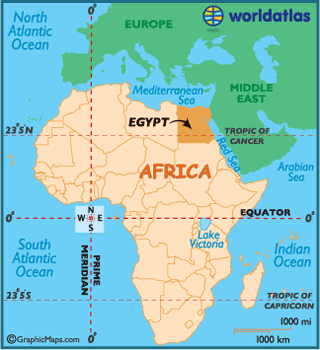
Egypt is not landlocked. Though most countries that suffer from the landlocked trap are in Africa, Egypt happens to be located on the coast, making it able to take advantage of the Mediterranean Sea and Red Sea. Coastal access is vital for a country, as it links the country to strong trade routes. This allows Egypt to trade more easily with other countries and maintain a steady flow of imports and exports. For this reason, the income Egypt gains from coastal trade helps keep the country out of poverty as well as prevents them from having to rely on their neighbors.

Additionally, Egypt is not greatly affected by the natural resource trap. Though Egypt is commonly thought of for its abundance of crude oil and petroleum products and exports a considerable amount of this yearly, Egypt seems hardly phased. Why? Well, Collier notes that the more natural resources a country has, the more competition and selectivity there is. Also, a country could then be controlled solely by a specific natural resource and all its other resources will become hardly competitive. However, with Egypt's location near sea trade routes, the transportation and exposure of Egypt's goods are greater than usual, so it seems that Egypt then doesn't have a problem with transporting its goods evenly. Not being landlocked clearly helps with this.

Conflict, in general, is a trap that most countries inevitably fall into. Egypt currently faces some internal conflict, for example the uprisings regarding the new Egyptian Constitution, and that naturally distracts Egypt's government and citizens from keeping peace and focusing on other crucial aspects of society. However, though conflict may sometimes be a trap for Egypt, bad governance is the trap Egypt mainly falls into.

In 2011, people from around the world watched as Egypt protested the rule of Hosni Mubarak. The 2011-2012 Egyptian Revolutions indicated that Egyptians had been battling bad governance and had finally bursted. These revolutions also indicated that Egypt had finally solidified in their minds what exact image represented a president for them. For example, Egyptians fought for free elections, freedom of speech, legitimacy and the end of emergency law. That is what they wanted and expected to see. Now, this image resonates even today with the new presidency in Egypt, as can be seen in the uprisings against Morsi regarding his declared rights regarding the Constitution drafting, as mentioned before.

Though Egypt is heading in a better direction with its government, "bad governance" is arguably its most prominent trap. A corrupt and uncooperative government prevented Egypt from progressing with the rest of the world, leaving it with a lot of "cleaning up to do" after Mubarak was ousted. Additionally, constant uprisings and a lack of confidence in the government proves to be detrimental to the economy, as less people will invest their money into the well-being of the country. Also, the uprisings in Egypt were violent and teared apart the overall stability and peace in the country. This trap though, did help Egyptian citizens consider their image and their President's image, which in the long run, will potentially bring about positive change.

Could these new changes in Egypt rid the country of the bad governance trap? I suppose only time will tell...